
What moving supplies do I need?
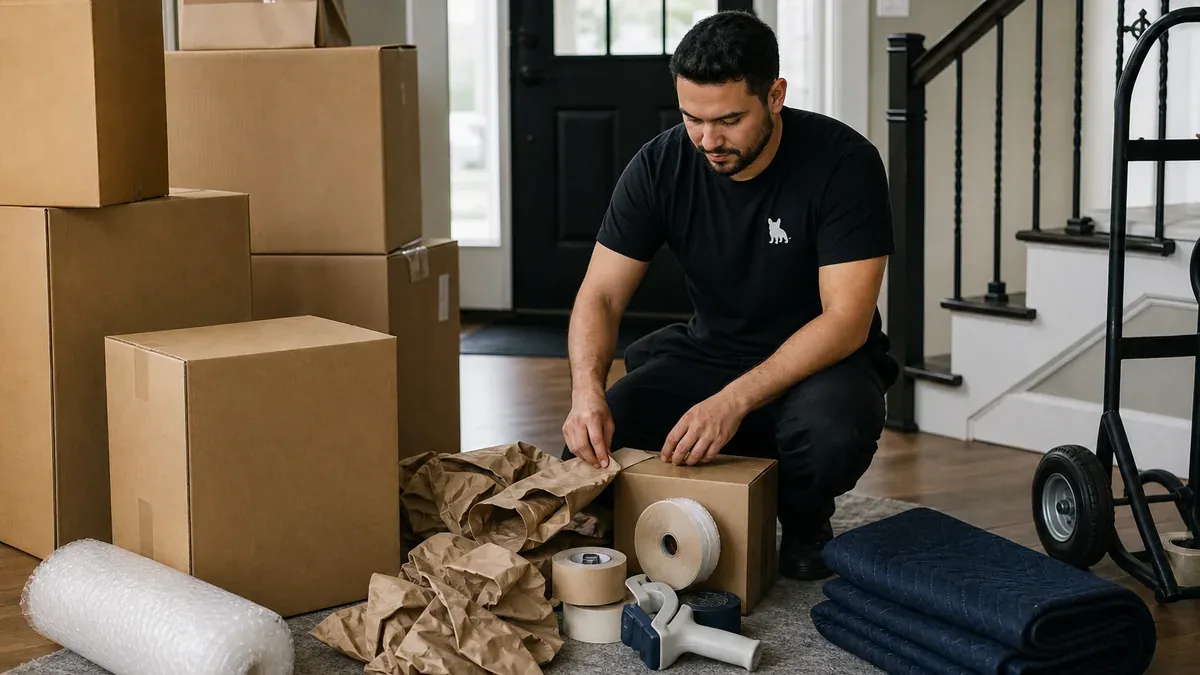
Most moves need sturdy boxes, packing paper, tape, markers, furniture wrap, mattress bags, wardrobe boxes, and fragile-item protection. Bulldog Movers can help match moving supplies to your DMV move size, inventory, packing timeline, and whether you are adding professional packing help.
- Best for customers who want boxes and materials planned before packing begins.
- Helpful for kitchens, closets, books, framed items, clothes, lamps, electronics, and fragile decor.
- Can be paired with packing services, local moving, long-distance moving, or labor-only loading.
What Bulldog moving supply planning includes
Common moving supplies to plan
- Small, medium, large, wardrobe, and specialty boxes matched to the move size.
- Packing paper, tape, markers, labels, stretch wrap, and protective materials.
- Fragile-item materials for dishes, glassware, framed pieces, lamps, and decor.
- Supply planning that connects packing, loading, transport, and unloading needs.
Clarify before buying supplies
- Do not overpack large boxes with books, dishes, or heavy items.
- Used or weak boxes can crush, split, or slow down the moving crew.
- High-value art, antiques, and specialty items may need custom materials or separate planning.
- Liquids, perishables, hazardous materials, and personal documents should not be packed like standard household goods.
Google customer proof
Reviews for Moving Supplies
Read real Google reviews that speak to the concerns behind moving supplies, including communication, careful handling, estimates, access, and crew professionalism.
If you are moving somewhere within Maryland, DC, or Virginia, you would have to be crazy to use anyone other than Bulldog movers. They are, without question, the best option. I would give higher than 5 stars if I could. I have undergone several moves with several different moving companies, and Bulldog movers is the best I have ever used, by a long shot. They operate by a standard of excellence that I didn't realize was possible. Carlos and Donald were absolutely incredible: they were timely, communicative, extremely nice and accommodating, and moved a ton of furniture,…
I did a ton of research into movers as this was my first time hiring movers and was so pleased with my experience. I read good reviews about bulldog movers, they were the better of multiple quotes and best of several reviews and after a call with Serena to chat through it i was sold. Freer customer service from time of booking to time of arrival to wrapping up. I had Johnathon and Aaron and they were on time, incredibly professional and careful with my belongings, so kind and delightful. We did take a bit longer but not their fault and worth every penny. They insisted i…
An awesome and seamless move! Luca, Aaron, and Jonathan were timely, friendly, and considerate. Asked lots of great questions and ensured our move was smooth; even with our home being a bit of a mess from our lack of preparation.
The set up process was easy. The responsiveness and flexibility in the changes I made were superb. Even to the point of actively helping me save money. The movers were great guys. Fun to talk to (they described moving a piano up 25 flights of stairs the day before) and respectful of property. They were lightning fast and thorough. They even helped me set up at the new place. Couldn’t be happier with whole experience.
Moving was super easy, all thanks to Bulldog Movers. Crew is very professional and make it so smooth! 5 stars is not enough 👏🏼
Excellent movers! Carlos, Donald, Aaron, and Jonathon helped me unload all of my belongings into my house, and were extremely pleasant, careful, and diligent. Probably the most enjoyable moving experience I’ve had in about 8 moves!
Luca and Alpha were wonderful. They showed up on time and worked diligently to get the move finished in a timely manner. I would highly recommend this company and these two movers in particular.
Very efficient and careful. The two guys (Jonathon & Alpha) were very professional. I’m helpful.
We used them for packing only and they were excellent from fist contact all the way through. Serena in the office is super responsive and accomodating and they were able to schedule the packing with 2 days notice. And the packing itself went flawlessly. As for price, I didn’t have time to get another quote, but they were very flexible only charging for the time spent working and the materials actually used. Be sure to check the distance from their base to your location. We were a bit far, but they only charged for one hour. Recommend them 100%
Danny, Carlos, and Gerson helped us with our move from Baltimore to Washington, DC. They were great! This was a tricky move with lots of moving parts. We had bad weather the day of the move, and the building we moved into had a tight window for our move-in because a move-out was happening at the same time. These guys made it happen. They were very friendly, professional, and FAST. I was amazed how fast they worked (packing and moving), and their positive attitude the whole time just made them fun to be around. I also appreciated that the moving company’s billing structure…
They were excellent and did everything they said they would do on time and within the budget we established together. When I didn't use all the packing boxes they sold me, they gave me credit. I could have paid a lot more for the services they provided, but the guys knew what they were doing - efficient, courteous, careful, organized and friendly. Local or Out of State, I think they do the same for everybody. You know from start to finish where you stand and what's going on. You can't do better than BullDog MoversMD.
Luca, Morrison, and Gerson are a wonderful team of movers that showed great care in packing and loading our belongings — many fragile — into boxes and into the truck. We are so happy that this team of three very nice men helped us! Luca, Morrison and Gerson are energetic, careful, happy and very pleasant to work with! I highly recommend each of them and will be asking for them again in the near future!
Bulldog Movers has helped me move twice in the past 3 years, and I would happily book them again! The crew that showed up for my 1 bed/1 bath move included Carlos, Alpha, and Jonathan, and they kicked ass the entire day. They moved all of my things with care and attention, but they also moved quickly. I was moving from a condo building, and the building staff said that the crew were polite and respectful of building rules and regulations. They were careful to put boxes and furniture exactly where they should go, and they were friendly while working so hard. I would happily…
I spent a lot of time deciding on which moving company I was going to use from all the different options in the area. I went with Bulldog Movers because of their 5-star rating and I’m so glad I did! I was very stressed out and had underestimated how many boxes I needed but Bulldog Movers put my unpacked items in some of their own boxes. I had Carlos and Andy, and both of them were friendly and calm which made me feel less anxious and above all, they were super efficient! We finished in 2 hours and since my original estimate was for 4 hours I paid less than I expected which…
I have worked with several moving companies, both internationally and domestically, and none have matched the exceptional service provided by Bulldog Moving Company. If it were possible to give more than five stars, they would certainly deserve it. From the outset, Serena demonstrated extensive knowledge, prompt communication, and a willingness to accommodate all of my requests. Frank and Donald were equally impressive—flexible, attentive to suggestions, and highly efficient in their process. Their work, from disassembly and secure packing to careful placement of every…
We recently used Bulldog Movers for a local move and I would highly recommend their services. Booking was easy and I receive a quick response every time I reached out with a question. Jonathon, Carlos, and Luca were professional, efficient, and communicative throughout the move. They carefully moved and wrapped all our furniture and when unloading made sure everything was where we wanted it to be. We ended up needing all the space in the truck, more then our estimate, but their work ethic and positivity never changed. We’re thankful for their expert packing ability down to…
All I can say is wow! This was a difficult move. The situation was tenuous and right from the start. Serena was phenomenal. The level of customer service that bulldog movers provides truly unparalleled. I want to give a huge thank you to Carlos and Donald. Besides their expertise in packing and preparing items for moving, they navigated a difficult situation with efficiency, aplomb and professionalism. Because the landlord was so uncooperative the move took several extra hours, cutting into their personal time that day. They never complained, they never lagged, and their…
Booked a large move with Bulldog Movers and couldn’t be happier. The 3 guys were very professional and friendly and wrapped everything nicely. It was raining and sleeting during the entire move and they had great attitudes about it. The unloading was also smooth and they dropped off boxes and furniture where I asked and neatly organized the things that didn’t have a place to be set. And they made sure to check multiple times what is and isn’t marked as disposal. They finished the job roughly around the time frame I was quoted which was several hours faster than another…
Bulldog Movers exceeded every expectation! From start to finish, this team made what's usually one of life's most stressful experiences feel completely effortless. Alpha, Luca, and Jonathan were absolute rockstars — punctual both days, incredibly professional, and they went above and beyond to accommodate every single special request I had. They handled both packing and moving flawlessly and wrapped up right on schedule. If you're moving anywhere in the DMV, you should absolutely trust Bulldog!
We were packed up and moved by, Jonathan, Luca, Frank, Carlos, and Donald. The team exceeded every expectation! They communicated early and often, keeping us updated as bad weather hit our schedule and still made everything work. They kept at or under estimates for each step and they were thorough and careful with every item. At packing, moving out, and moving in, the team made sure we were comfortable with all quality of work and addressed every concern we had. Would hire them again!
I have moved so many times, and Bulldog has been the best experience. From Serena’s amazing customer service, expert estimating, and communication to Danny, Carlos R., Oscar, Luca, Donald and Carlos’ efficient packing and moving. Not a single broken item or scuffed wall, clear labeling, furniture handled with absolute care, fair pricing, and an incredibly friendly and thoughtful team. They went above and beyond, I would absolutely recommend them to anyone.
This was my first time using movers, and it was worth every penny. The guys were incredibly helpful with wrapping our bigger items and were efficient with getting our boxes loaded and unloaded from the truck. All our items, including the delicate items and IKEA furniture, arrived in one piece, unbroken! The price was also a lot lower compared to others in the area. I would absolutely use Bulldog again.
Did a move within the city with them from a third floor walkout, they were incredibly professional and efficient. The time was exactly what was quoted to me (although we had slightly more boxes than expected). They wrapped everyting up prior to bringing it out to the truck. We worked with Danny, Carlos R., Oscar, and Jonathan. They were great!
We had a great experience with Bulldog movers yesterday for a local move. Danny, Carlos and Jonathon were a fantastic, trustworthy team who handled all of our furniture and things with great care. The entire team was fantastic at communicating as well! Unfortunately for a variety of reasons, our move took double the time than was originally estimated, but the crew were so respectful and pleasant. They kept up a great attitude and work ethic from start to finish. We also had a hiccup with another move running well over into our reservation of the service elevator in our…
What affects moving supply cost?
Studios, apartments, townhomes, offices, and full houses need different quantities and box sizes.
Books, dishes, wardrobes, electronics, framed items, and lamps each need different materials.
Professional packers, partial packing, and DIY packing use supplies differently.
Paper, bubble wrap, dish packs, dividers, lamp boxes, and specialty materials add protection.
Last-minute packing often requires a clearer supply plan so boxes and materials are available on time.
How Bulldog Movers helps plan supplies
- 01
Review your inventory
Share rooms, closets, fragile items, books, clothes, kitchen items, and office materials.
- 02
Match supplies to rooms
Plan the right mix of small, medium, large, wardrobe, and specialty boxes.
- 03
Protect fragile items
Choose paper, wrap, dividers, padding, and specialty materials based on item risk.
- 04
Coordinate with packing
Decide whether you are packing yourself or adding Bulldog packing services.
- 05
Label for unloading
Use room labels and clear markings so boxes land in the right place at delivery.
Compare moving supply options
| Topic | Option | Best for | Tradeoff |
|---|---|---|---|
| Mover-planned supplies | Customers who want supply quantities connected to the actual move and packing plan. | Requires sharing inventory and room details before packing starts. | |
| Store-bought boxes | DIY packers who know their room count and can buy supplies early. | Easy to underbuy, overbuy, or choose boxes that do not fit heavy or fragile items. | |
| Used boxes | Light, low-risk items when boxes are clean and sturdy. | Weak boxes can fail, crush, or make stacking harder in a truck or pod. |
Moving supplies FAQ for DMV moves
What moving supplies do I need?
Most moves need sturdy boxes in multiple sizes, packing paper, tape, markers, labels, stretch wrap, furniture pads, mattress bags, wardrobe boxes, and extra protection for fragile items.
Can movers bring boxes?
Movers can often help plan boxes and supplies when that need is included in the quote. Confirm supply needs before packing or moving day so the right materials are available.
How many boxes does an apartment need?
The number of boxes depends on apartment size, closets, books, kitchen items, decor, and how much you own. A studio may need far fewer boxes than a two-bedroom apartment with a full kitchen and office.
What supplies protect fragile items?
Packing paper, bubble wrap, dividers, dish packs, padding, tape, and appropriately sized boxes help protect dishes, glassware, framed items, lamps, and delicate decor.
Are wardrobe boxes worth it?
Wardrobe boxes are useful for hanging clothes, coats, formal wear, and closets that you want moved with less folding and repacking.
Should I use small boxes for books?
Yes. Books, dishes, and other dense items should usually go in small boxes so they stay liftable and do not break the box.